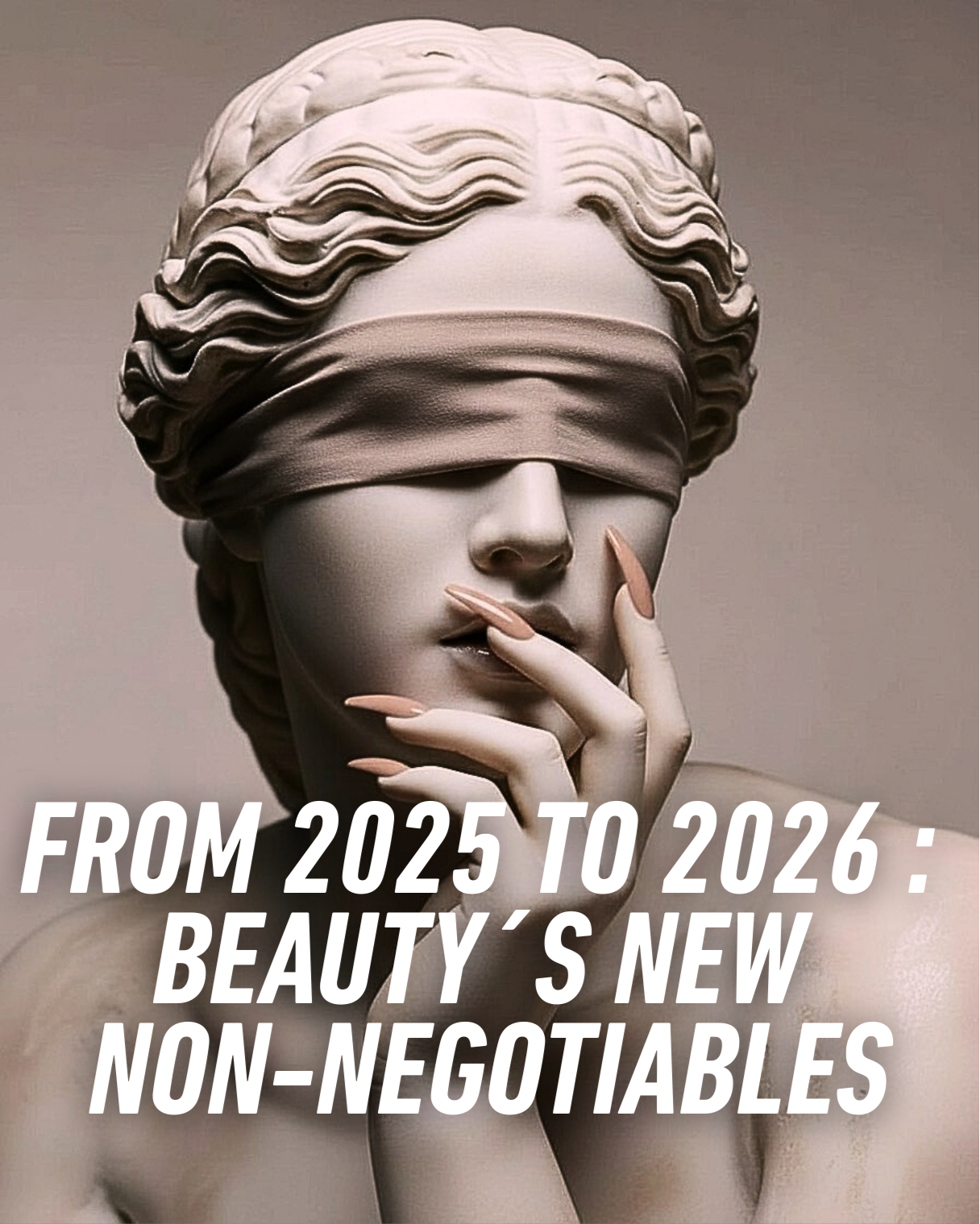
2025 has felt like a beauty hangover. The industry is still loud, still launching, still glossed—but the people watching it are more tired, more online and much harder to impress. Between inflation, TikTok‑fuelled discovery and a wave of new indie and celebrity brands, European consumers now expect more than pretty packaging, nepo‑baby launches and recycled heritage stories.
Going into 2026, some things don’t feel optional any more. They’re the quiet non‑negotiables: the checks people run in their heads before they click, restock, recommend or add yet another product to an already crowded shelf.

Non‑negotiable #1 – Value over logos: how 2026 beauty shoppers in Europe are redefining “luxury”.
2025 was the year European beauty tried to keep its glow while consumers did the maths. Overall, beauty and personal care spending in Europe is still edging up, but prestige has clearly hit a breakpoint, especially in markets like France, while mid‑range brands are gaining momentum. Circana data shows mid‑priced skincare now growing roughly twice as fast as traditional prestige in Europe.
At the same time, ultra‑luxury pushed pricing into headline territory. Louis Vuitton’s La Beauté debut, with lipsticks around 160$ and eye palettes around 250$ , became a shorthand for how detached some launches feel from everyday reality. In contrast, K‑beauty has quietly spent the last decade educating Western consumers that sophisticated textures, layered actives and strong results can come at far more approachable price points. Korean brands are now expanding from niche to mainstream: K‑beauty specialty shops are multiplying in European capitals, big retailers like Sephora are doubling their Korean skincare portfolios, and players such as Olive Young are preparing a physical push into the US with a mix of affordable, innovation‑driven brands.
Is this the perception shaping 2026? European consumers haven’t turned their backs on beauty, but they have started interrogating every euro—asking whether a product’s texture, ingredient load, refill logic, durability or skin results genuinely outperform cheaper options that often look and feel just as premium. In this landscape brands and launches that rely only on heritage storytelling and eye‑watering tickets, without a clear story of added value, increasingly read less as aspiration and more as a disconnect from how people actually shop.

Non‑negotiable #2 – Representation in beauty : who really gets centred in 2026 campaigns.
If 2010s diversity was about big declarations, 2025 has been more about who quietly sits at the centre of the frame. On runways and red carpets, images like Anok Yai being named Model of the Year, Michelle Yeoh continuing to collect global honours and step onto major stages, and a wave of Asian and Black actresses leading film campaigns have reset who feels “default” in prestige beauty and fashion.
Behind those faces, a growing group of Asian artists and founders are shaping what glamour looks like day to day. Nina Park’s minimalist, skin‑first red‑carpet makeup has become a reference point across Hollywood and social feeds, with her “Nina Park effect” cited as one of the most desirable beauty moods of the year. Patrick Ta’s brand continues to scale as a celebrity artist‑led label, while Hung Vanngo’s namesake line, launched at Sephora with a full colour wardrobe and strong backing, shows how an Asian founder’s aesthetic can now anchor a global colour brand from day one.
What audiences are reading now is consistency and authorship. It is no longer enough to cast one striking face or hire one star artist for a hero moment; people are tracking who appears across seasons, who is behind the brush, whose name is on the brand, and how that flows through. In 2026, the work that will feel believable is the work where casting, founders, creative teams and visual language are aligned.

Non‑negotiable #3 – AI and beauty : why tech can help, but humans still lead.
In 2025, beauty brands pushed generative AI into almost every corner of their workflows—moodboards, concept sprints, draft copy, skin‑diagnosis interfaces and fully synthetic campaign images. Some of it unlocked real speed and genuinely fresh visual ideas; some of it produced work that felt airless and interchangeable, with faces and textures smoothed into a fantasy that no longer seemed connected to human skin.
On a personal level, there is also a real fascination ( Ok… I am obsessed with generative AI ) Generative images and videos can feel addictive precisely because they turn vague dreams into instant visuals: impossible textures, hybrid creatures, cinematic bathrooms, other‑worldly makeup looks. In a year saturated with heavy news—war, conflicts, climate anxiety, cost‑of‑living stress—it is understandable to want that escape, to keep scrolling through a parallel universe where everything is soft, controlled and beautifully lit.
But that is also where the “dark side” of the illusion starts . The more time we spend in AI‑shaped worlds, the easier it becomes to normalise filters, poreless skin, anatomically impossible faces and “no‑effort” beauty standards that quietly raise the bar for everyone offline. Going into 2026, the non‑negotiable is not to reject AI, but to frame it clearly as a tool keeping the human eye and hand in charge and stopping beauty from drifting so far into algorithmic dreaming that it forgets the people it was supposed to be about.

Non‑negotiable #4 – Wellness, skin and burnout: 2026’s real “self‑care” trends.
The language of “self‑care” has been everywhere for years, but 2025 made the tension much sharper. At one end, there is fast‑growing interest in formulas and rituals that really address sleep, nervous‑system balance and stress‑inflamed skin—adaptogen serums, barrier‑repair creams, “circadian” products, nutricosmetics and supplements that promise calm from the inside out.
At the other end, skincare has started to look a little dystopian. The 2023 “Sephora kids” phenomenon and the wave of children’s skincare launches sparked concern as tweens bought potent anti‑ageing products, layered double‑digit actives and picked up adult influencer language about wrinkles and “glass skin” for faces that are still developing. On TikTok, over‑exfoliation, barrier damage and multi‑step routines are common enough that dermatologists regularly warn against piling on acids, scrubs and tools in the chase for a poreless finish.
Face masks and tapes have become part of this performance. Mask content continues to flood feeds under hashtags like #facemask and #masktok, while taping trends—from overnight patches to mouth and face tape promising lift and wrinkle prevention—blur the line between playful experiment and low‑grade body surveillance. In parallel, “eat your skincare”–style trends, from collagen shots to probiotic and adaptogen blends, reflect a real move towards beauty‑from‑within—but also risk suggesting that every skin insecurity has to be managed with yet another product or ritual.
All of this pushes beauty closer to mental health, whether the industry likes it or not.
Routines and stories that allow texture, redness, breakouts and fluctuating energy—rather than erasing them—are likely to resonate far more than another beige‑bathroom fantasy where stress, screens and real skin never appear.

Non‑negotiable #5 – Too many launches? Beauty brand, celebrity brand and sustainability fatigue
One of the quiet truths of 2025 is that beauty feels saturated—even as the numbers keep climbing. Europe remains one of the most mature cosmetics regions, with steady growth but also dense competition, layered distribution and a constant stream of newness hitting shelves and feeds. Analysts describe an “insane” pace of product launches, with some established skincare brands doubling their yearly number of releases compared to pre‑2020 levels. For many people inside and outside the industry, it has become genuinely hard to remember which launch did what, and why the 27th serum in a line deserves a place next to the other 26.
On top of that, the celebrity and creator brand wave is testing everyone’s patience. Global data shows a steady uptick in celebrity beauty brand launches each year since 2020, and 2024 was already on track to surpass previous records before the year even ended. The question that keeps surfacing is simple: do we actually need another brand—or just better, sharper brands?
Behind the jokes sits a heavier reality: every extra range means more extraction, more manufacturing, more packaging and more carbon, in an industry that already leans on plastics, complex logistics and resource‑intensive ingredients. When formula differentiation is thin and packaging is mostly about shelf presence, “just one more launch” stops being innocent; it becomes part of a wider sustainability problem that beauty can no longer outsource to recycling messaging.
New launches still cut through only when they add something genuinely different in format, technology, sensoriality or story—and increasingly, when they can justify their footprint with real utility and longevity. In 2026, the question is less “what else can we launch?” and more “what truly deserves to exist?”—for brands, for pros, and for the planet sharing the bathroom shelf

Beauty doesn’t flip a switch on 1 January, but you can feel the mood shifting.
People are asking clearer questions: is this really worth my money, do I see myself in this image, is this routine kind to my nervous system, do we honestly need another launch on this shelf ? Brands can’t ignore that for much longer.
Going into 2026, the work that will feel right is the work that answers those questions genuinely and lead the way.
CodeSkøn will be there, reading the signals with you and keeping an eye on where the industry actually walks, not just where it says it wants to go.
Missing something? Add your tips in the comments