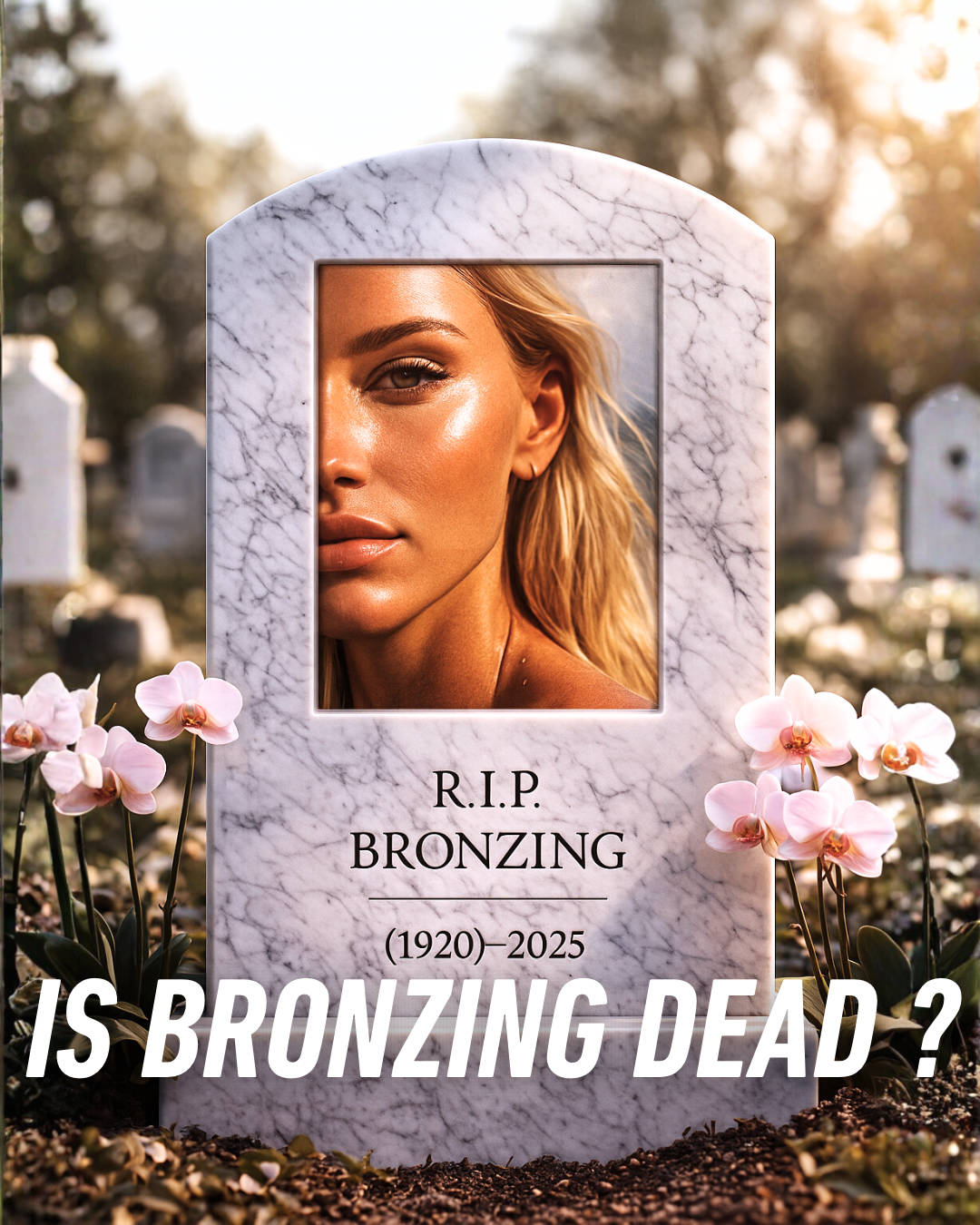
How SPF culture, dermal tech and East-Asian aesthetics rewired beauty’s relationship with the sun.
I grew up in the bronzing decades.
In the late 90s and early 2000s, tanning wasn’t a preference—it was a code.
We chased colour like status: body oils at the beach, solarium cards ( Guilty of charge ) , carotene supplements, even picking foundations deliberately darker to secure a perpetual holiday glow. Bronze was shorthand for leisure, desirability, vitality—an aesthetic that promised health even when dermatology disagreed.

Today, the most aspirational complexion is the one the sun never touched.
Not porcelain—preserved.
Bright, hydrated, translucent.
Glow achieved not through UV exposure but through control: SPF 50, barrier serums, antioxidant layering, hydration rituals. The tan has lost its glamour; the glow of protection has replaced it.
The Anti-Tan Era is not nostalgia. It is a cultural correction.

Did Technology killed the tan ?
The shift did not start in fashion weeks or in skincare aisles—it began in clinics and cameras.
Dermal scanners, UV imaging and AI complexion tools revealed what mirrors could not: sub-surface pigment reservoirs, early photoaging, broken capillaries. When consumers saw their future skin, tanning stopped being a colour and became a risk.
Influencers accelerated this transformation—not by showing tans, but by sharing dermal scans, pigmentation relapses, “skin age” ratings, and melasma flare-ups after summer. The tan was no longer an aesthetic; it was a health liability documented in real time.
Dermatology as a field has been warning of UV-driven aging for decades—premature collagen loss, textural degradation, pigment disorders—but the message only landed once technology made the damage visible.
This wasn’t medical authority—it was awareness.
The devices created literacy.
Social media did the rest.

Let’s be very precise as this is a key topic that drove my interest in writing this post :
This shift is not a return to outdated ideals of shade hierarchy.
IT IS NOT :
• “lighter skin is better”
• “pale tones equal beauty”
• “bronze is unattractive”
It is a response to how we understand skin health today.
The beauty consumer of 2025 is influenced by:
• clinical evidence of UV damage
• psychology of longevity and prevention
• skin analysis technologies that quantify risk
K-Beauty and Japanese skincare didn’t impose whiteness—it offered a system
East-Asian skincare philosophies simply offered a usable alternative:
hydration, ritual, barrier care, pigment stability, texture clarity.

The global fascination with East-Asian routines didn’t emerge because they presented a racial ideal; it emerged because they presented control.
Layered essences, moisturising toners, brightening actives—not as colour erasure, but as predictable, repeatable skin behaviours. Prevention became aspirational.
The complexity of language around skin tone is well-documented.
The study “Whiteness as Beauty: A Critical Analysis of South Korean Tone-Up Cream and Sunscreen Advertorials” highlights how historic marketing sometimes used “whitening” as shorthand for luminosity or clarity—advertising semantics rather than ethnic superiority.
Reporting from the Pulitzer Center on “Cinderella” and “Snow White” whitening injections shows how such treatments sparked internal debate in South Korea, reflecting that these ideals are questioned within their cultural context—not just externally.
So globally we now say we imported “care.”
But did we also inherit the idea that lighter skin looks safer?
⸻

The glow is no longer sun-made—it’s lab-made
Bronzing once communicated glamour and time outdoors.
Today, glow communicates curation: ceramides, hyaluronic acid, peptides, LED masks, niacinamide, tranexamic acid, retinol, and SPF layered like fragrance.
The prestige skin is luminous, diffused, humidity-sealed.
Not “golden heat”—clinical luminosity.
Editorially, the conversation has shifted.
Fashion and beauty media talk about barrier integrity, collagen preservation, melanin management.
Even Vogue Business frames new beauty positioning around “skin health”, noting a consumer shift away from colour-driven aesthetics toward texture, hydration, and longevity.
Bronze says “I lived.”
Glow says “I learned.”
More to explore on the conversations here :
https://www.vogue.com/article/inside-k-beautys-second-coming
https://www.voguebusiness.com/tags/beauty-spf
⸻

Protection, not pigmentation, drives the Anti-Tan Era
Tech quantified damage.
Dermatology contextualised risk.
Social platforms made vulnerability public.
Consumers internalised the lesson.
East-Asian skincare philosophies simply provided the toolkit:
hydration, routine, barrier care, texture clarity—never shade hierarchy.
The Anti-Tan Era does not ask anyone to erase pigment.
It asks them to avoid damage.
⸻

Bronzing fatigue: a social code expired
Bronzing hasn’t been cancelled—it has been culturally outgrown.
Where my generation saw solariums and shimmering oils as confidence,
Gen Z sees SPF 50, mineral sunscreens, antioxidant mists, and lab-grade diagnostics as identity.
Bronze no longer represents freedom.
It represents repair.
It represents clinic visits.
It represents hindsight.
Anti-Tan does not say “be pale.”
It says protect the future you.
Beauty didn’t become lighter.
Beauty became strategic.
A closing reflection on the above :
The Anti-Tan Era isn’t a judgement or a rejection.
It is a recalibration between pleasure and proof — between the sunlight we glorified and the consequences we can no longer deny.
Some trends return every decade.
Bronzing might not.
Not because it isn’t beautiful, but because it will need a new meaning—one built on prevention, not social classification, and NEVER on skin tone as status.
And what are your thoughts about the era of bronzing ?
Missing something? Add your tips in the comments